After 10 years at the Coalition and three years as Executive Director, Caroline Lucas is moving on. Through some of the most challenging and historic moments for our partnership and in our Coalition, she has been a fierce advocate for frontline workers, always fighting to build power and push for the staffing, wages, and respect we all deserve. While she is stepping away from her role, she will remain in the labor movement and close to frontline workers, continuing to build worker power.


This transition is a reminder that our movement is bigger than any one person—it’s powered by you, the frontline workers standing together. Our fight for safe staffing, fair wages, and a real voice at work continues stronger than ever.


Caroline’s leadership has shaped our movement in profound ways. She has always centered you—the 85,000 frontline workers who make up our Coalition—lifting up new leaders and ensuring our collective power continues to grow. We are deeply grateful for her vision, mentorship, and unwavering commitment.


Stepping in as Interim Executive Director is Natalie Holtzinger-Cruz, who currently serves as our Staff Director. Before joining the Coalition, Natalie fought alongside healthcare workers at SEIU 1199NW, leading teams and bargaining strong contracts. She is  the experience, strategy, and grit, needed to take on the next phase of our fight. She knows what it takes to organize, build a strong partnership with integrity, and make real change happen. Whether speaking out with frontline workers or strengthening our structure behind the scenes, Natalie brings a balance of strength, creativity, and commitment—making her the right leader for this moment.


Please join us in thanking Caroline for her years of leadership and welcoming Natalie into this role. The work continues, and together, we are unstoppable.
In February, thousands of Coalition members took action, hand-delivering valentines to Kaiser Permanente demanding the full payout of the 2024 Performance Sharing Program (PSP). Every region participated, standing together in a unified call for fairness and respect.

During bargaining, Kaiser committed to providing timely and transparent PSP data—a fundamental part of our agreement. Yet, in 2024, they provided only two data updates all year, with some metrics delayed by seven months. This left frontline workers in the dark, unable to track performance or make course corrections. This lack of transparency is not just unfair—it undermines the National Agreement and the core principles of our partnership.

Because we stood together, fought back, and refused to accept broken promises, we got more.

This victory didn’t come easy. Every day, we showed up, provided care, and worked to meet our PSP goals. But Kaiser Permanente wasn’t doing their part. If we had accepted that, we would have received far less. But that’s not who we are.

We don’t sit back—we fight.

This win is proof of our power as a Coalition. Every email, every valentine delivered, every conversation with management—it all made a difference. Kaiser heard us loud and clear: frontline workers will not accept anything less than fairness and respect.

We should be proud of what we achieved together. This fight was about more than just PSP—it was about holding Kaiser accountable. And while we pushed them to do better, this fight isn’t over.

We must keep demanding transparency and real accountability, so we’re never put in this position again. Partnership means fairness—and we will continue holding Kaiser to their commitments.

What we do matters. What you did made the difference. And together, we will keep fighting for the fair treatment and respect we deserve.

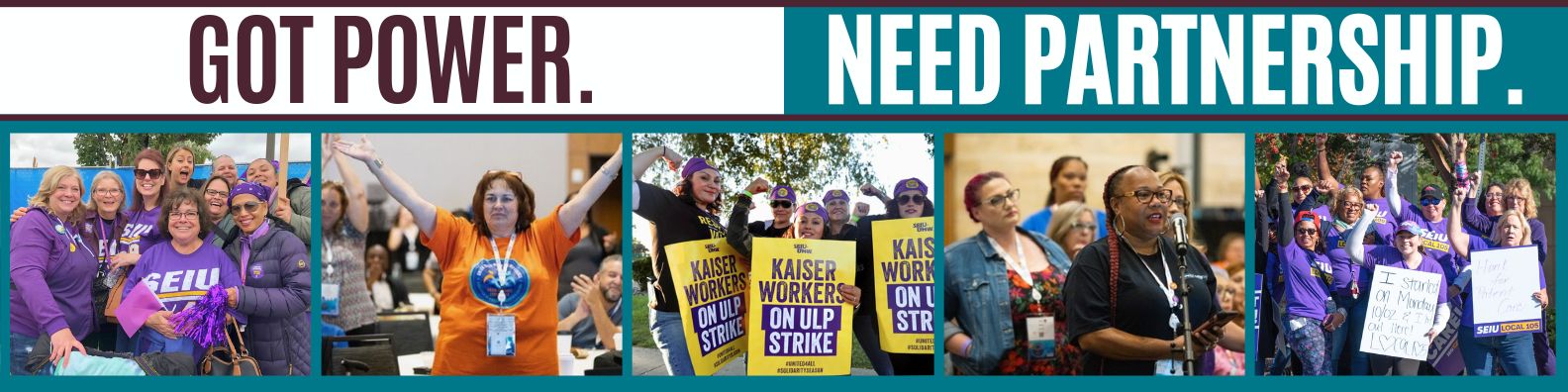
On the one-year anniversary of our historic strike and groundbreaking contract, Coalition union members across the nation delivered the same message to Kaiser leadership: We got power. Now, we need partnership.

Whether it was signing the open letter and delivering it to Kaiser leadership or wearing our union gear on the October 3rd Day of Action, Coalition union members showed up strong.

As we enter the second year of our contract, it’s time for Kaiser to step up to stabilize our Partnership through:
· Staffing & Job Security: it is simple– more staff, less registry, and no outsourcing
· Investments in the frontline: upskill current workers and recognize new SEIU CIR members
· Partnership & Accountability: guarantee UBTs meet regularly, go all-in on Joint Staffing, and take responsibility for PSP data and goal setting.

We know what it will take to make this Partnership strong for years to come. And we are ready to make it happen!

#CoalitionStrong #UnionProud #United4All

We did it. Coalition union members met the goal of having 40% of prescriptions delivered by mail and we stopped increases to our prescription copays. Rx copays will remain $10 for in-person pickup and $5 per mail delivery for Coalition union members (NW and WA region rates may vary but will remain the same). We saved hundreds of dollars in increased Rx costs from budgets already squeezed by high inflation rates.

Locking in our current low copays did not just happen; we worked for it. Dozens of Mail Order Pharmacy Champions walked the floors and had thousands of face-to-face conversations. Member leaders presented at huddles and union meetings. We had tens of thousands of member-to-member text exchanges in a matter of days and followed up through email. 62,000 of you took our KP Learn course to understand what was at stake. Together, we educated and activated each other to take action to stop Rx copay increases.

We showed that we have a strong network that can reach and move tens of thousands of members to action. As a Coalition of twelve unique locals, we coordinated our goals, got to work, and got results through our organizing.

Bargaining begins on April 18, and we have our work cut out for us— but we are 85,000 strong. We have each other‘s backs, and we can do anything we put our minds to.

Kaiser has finally released its 2022 financial results. For the first time in many years, Kaiser announced a loss of $4.5 billion, with a $1.3 billion loss in operating revenue and a $3.2 billion loss from investments. Despite this, Kaiser still has tens of billions in liquid assets. Now, because of Kaiser’s misplaced fiscal priorities and investment losses, Coalition Union members will not receive a Performance Sharing Program (PSP) payout. 

One clear driver of Kaiser’s expenses is its excessive spending on contract labor. In 2022, 11 of the 20 hospitals in the country that spent the most on temporary staff were Kaiser facilities. Kaiser paid over $2 billion to for-profit staffing agencies instead of investing in its own workforce.

We show up every day for each other and our patients. We do our part to meet PSP goals and do our jobs well, despite massive understaffing and the ongoing challenges with the pandemic. If Kaiser would invest more in us, it could improve the quality of patient care, stabilize our workforce, and stop spending so much on expensive contract labor.

PSP is a negotiated benefit of the National Agreement for Coalition Unions and is designed to recognize frontline workers’ contributions to Kaiser’s success as an organization. In recent years, Kaiser has set financial gate triggers around their profitability that are unrealistic and out of the line of sight of any frontline worker. While these metrics are contractually allowed, they sidestep the spirit of the PSP and partnership principals themselves.

Coalition Leaders Push for Broad Recognition of Workers’ Contributions, Kaiser Agrees to $500 bonus

Coalition union leaders called upon Kaiser to recognize the important contributions of frontline workers. Kaiser has agreed to our request and will make a special one-time payment of $500 to most Coalition union represented workers. Those who qualify for the CA state retention payment will not receive the $500 bonus*. Kaiser currently anticipates distributions in April or May.

Although we have earned more, the real conversation about getting the respect and recognition we deserve will be had at the National Bargaining table this year.

First Bargaining Dates Set!

National bargaining will begin April 18-20, 2023. It’s clear we have a fight on our hands to get Kaiser focused on solving the staffing crisis and ensuring quality care for our patients. Reforming the PSP and how it is paid out will also be a big piece of our bargaining work. Stay tuned on how you can get involved!

*CA State-Sponsored Staffing Stabilization Bonuses

The California Legislature and Governor included more than $1 billion for retention bonuses for healthcare workers in the state budget signed last June. Employers had to apply for the bonus by January 6, which Kaiser did. Under that program, eligible full-time Kaiser employees will receive one-time payments of up to $1,500; part-time employees will receive up to $1,250. 

Thank you to the immense leadership and hard work of SEIU-UHW members for bringing about this successful campaign.

Last week, the California Nurses Association (CNA) reached a tentative agreement (TA) with Kaiser Permanente after months of solidarity actions, including an almost unanimous strike vote. Like Coalition union members, CNA members are facing chronic short staffing, lingering pandemic stress, and burnout.

Their TA includes 22.5% in wage increases over four years, enhanced retiree medical benefits, and accelerated investments in staffing via the expansion of new grad/resident positions and training opportunities.

What does this mean for Coalition Union members and our upcoming bargaining? Are KP execs moving in the right direction to address the broader healthcare worker staffing crisis? We hope so. But we know it will take more than one contract for one group of workers to solve the far-reaching healthcare worker staffing crisis. 

From EVS and nutrition services to OR techs and sterile processing, from pharmacy and Clinical Labs to schedulers and medical assistants– all positions are critical to keeping hospital and clinic doors open. Our work matters. Without us, hospitals and clinics come to a grinding halt.

Next year we begin bargaining for a new National Agreement for 85,000 Coalition union members. We must stay laser-focused on moving KP execs to address the healthcare staffing crisis as a whole and stabilize our workforce.

On the 25th Anniversary of the Labor Management Partnership, Coalition union members nationwide delegated local Kaiser leaders with personalized messages on the worker staffing crisis and its impacts on patient care— and it was powerful.

Frontline workers are exhausted and burnt out. Skyrocketing inflation is eating away at our wages and raises. We have to fight to get an extra day off and are pressured to work overtime because of short staffing. Attrition and vacancy levels are at an all-time high.

It does not have to be this way. We must use the Partnership to focus on retaining existing employees and hiring before things get any worse.

Last month, the Coalition sent this letter calling on Kaiser Permanente to address the healthcare worker staffing crisis by:

  • Streamlining hiring
  • Adjusting pay scales to attract talent, including a $25 minimum wage
  • Addressing worker burnout
  • Accelerating workforce training and job placement

Kaiser, it is time we get to work.

Kaiser takes aim at workers’ right to sympathy strike with a frivolous lawsuit against IFPTE 20.
Coalition Unions stand together against egregious attacks on workers.

Headed to a virtual meeting? Right-click to save an image below to use as a virtual background and get the conversation started on keeping prescription copays low.

The Coalition of Kaiser Permanente Unions is pleased to announce Caroline Lucas as Executive Director. Caroline has worked with the Coalition, and in Partnership, for seven years, first as a National Coordinator in Northern California and, most recently, as Deputy Director. She will be the first woman to lead the Coalition in its 26-year history.

The Coalition Executive Board has the utmost respect and confidence in Caroline Lucas to lead the Coalition of Kaiser Permanente Unions on a successful journey to enhance the work-life of union members and our upcoming contract negotiations.”


-Tamara Rubyn, Coalition of Kaiser Permanente Unions Executive Board Secretary-Treasurer and President of OPEIU Local 29


Bringing nearly two decades of experience working in the labor movement, Caroline excels at tackling challenges facing modern healthcare workers and driving programs that result in an expanded voice on the job for working people. We are fortunate to have her strong leadership and negotiation skills to support us in preparation for 2023 National Bargaining.


“Next year marks the beginning of negotiations between our Coalition of frontline worker unions and Kaiser Permanente, the largest employee contract in healthcare. We must work towards a future where frontline workers have the respect, means, and support needed to continue to deliver top-quality patient care no matter the challenge. 


I am excited to work with union leaders and management partners to maintain Kaiser’s position as an industry leader in providing care and as the best place to work.” 


-Caroline Lucas, Executive Director, Coalition of Kaiser Permanente Unions


We would like to also thank Steven Ward for his leadership these past two years through one of the most tumultuous times in recent history. After 30 years in the labor movement, Steven has retired from this role to explore new opportunities. During his time leading CKPU, our unions successfully negotiated one of the best COVID benefit packages in healthcare and expanded Performance Sharing Program payouts. We wish Steven the best on the next stage of his journey.

For weeks, the Coalition of Kaiser Permanente Unions (CKPU) has been in continued discussions with Kaiser about the PSP bonus for regions they say did not meet the “financial gate” necessary to trigger a PSP bonus which applies to every region except Northern California. There are ongoing disputes that are currently being adjudicated on the link between the financial gate and PSP bonus payout in several regions.

The Coalition called on Kaiser to pay the full PSP bonus to all Coalition union members regardless of the financial trigger, but they were not willing to do so. Kaiser initially offered to pay $1000 to full-time workers and $750 to part-time employees (coded less than 32 hours).

Coalition union leaders across the nation expressed our strong and widespread disappointment with Kaiser’s position. Now, Kaiser has agreed to increase their “thank you” bonus payout to $1500 for employees who were coded at 32 hours/week or more in 2021 and $1000 for those who area coded at less than 32 hours/week, regardless of the region meeting the financial gate. On-call and per diem workers are also eligible for this bonus.

Employees whose bonus or incentive plan met their targets and are expected to pay out more than $1500 will receive the higher payout. In NCAL, where the financial gate was met, PSP bonuses will be based on how each service area and the region overall performed on the goals established for the year (details available later this month).

Bonuses will be paid in March of 2022. Employees in SCAL must have been hired/rehired prior to 9/27/2021. Employees in NW, HI, CO, and MAS must have been hired/rehired prior to 10/02/2021. There is no comparable hire/rehire date requirement for NCAL or WA employees.

Please contact your local union representative with any eligibility questions or concerns.

The uncertainty around the PSP bonus this year is one more reminder of the importance of 2023 bargaining and our need to be united and ready to stand up for fairness and recognition.

Letter from Steve Shields, Senior Vice President on 2021 PSP Payout

National Agreement PSP information: Section 2, pp. 57-61

Kaiser has announced that every region in the country, with the exception of Northern California, did not make the “financial gate” necessary to trigger a payout of the PSP bonus this year under our National Agreement (Section 2, pp. 57-61). Every year, Kaiser unilaterally sets a financial goal based on a projected operating margin (the amount of operating revenue over operating expenses). If the region doesn’t reach that financial gate, then the PSP is not paid, regardless of how Coalition union members did on the performance goals (there are ongoing disputes on this link in many regions).

Upon hearing of the possibility of not making the financial gate, due mainly to increased COVID expenses, the Coalition of Kaiser Permanente Unions (CKPU) met with Kaiser’s national leadership on February 4th. The Coalition’s proposal called for a full PSP payout in light of the extraordinary commitment shown by Kaiser employees throughout 2021. Coalition Union leaders admonished Kaiser for pinching pennies when it comes to frontline staff, as other hospitals offer large recruitment and retention bonuses to highly in-demand healthcare workers.

At that meeting, Kaiser’s initial position was that, while they are unwilling to pay the full PSP in regions that did not make the financial gate, they will provide some bonus in those areas. In the Southern California, Northwest, Washington, Colorado, and Mid-Atlantic regions, they are willing to pay anyone who worked 1,800 hours or more in 2021 a $1,000 bonus. Anyone hired as of Sept. 27, 2021, who worked less than 1,800 hours in 2021, would receive a $750 bonus under Kaiser’s plan. This applies to on-call workers as well. In Northern California, where the financial gate was met, PSP bonuses will be based on how each service area and region performed on the goals established for the year (details TBD).

The Coalition is currently awaiting a response from Kaiser management on our latest proposal.

It’s disappointing that Kaiser has indicated they will not be paying full PSP bonuses everywhere this year. While it’s true that COVID has impacted the operating margins, Kaiser continues to make billions of dollars from its investments and can afford to do better. This is one more reminder of the importance of 2023 bargaining and our need to be united and ready to fight for what we truly deserve after multiple years of putting our lives, our health, and our emotional well-being on the line for our patients.  

We now are calling on Kaiser to demonstrate a basic level of equity and decency in its approach to bonuses this year. In any region where frontline caregivers are receiving reduced bonuses because the financial gate wasn’t achieved, we expect executive leadership and management at every level to share the sacrifice. If respiratory therapists and EVS workers will only be seeing $1,000 bonuses, then the same must be true for managers in the region from department-level supervisors to regional presidents. This is simple fairness and speaks directly to Kaiser’s values. We will be watching.

OUR OFFICES

1775 K Street, Suite 390 | Washington, DC 20006 | Main: (202) 844-1520
1 Kaiser Plaza, 21st Floor | Oakland, CA 94612 | Main: (510) 267-2158